The Salmonids and Grizzco
A warrior culture from the sea, and the company that hunts its eggs
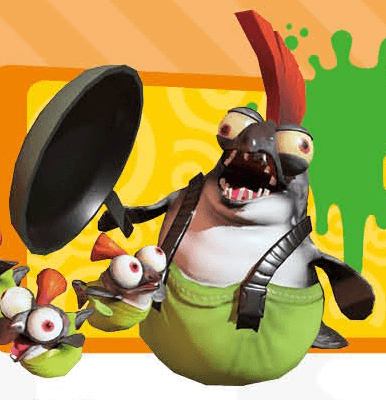
Salmon Run, introduced in Splatoon 2, is a cooperative mode with a lore problem hiding inside it. Who are these fish, why are they so angry, and why does a company want their eggs? The answers, spread across Sunken Scrolls, in-game manuals, and Splatoon 3's story, turn a horde mode into a genuinely strange piece of worldbuilding.
The Salmonid life cycle
Salmonids are fish that, like the cephalopods, evolved after the flood, but they took a different path. They never developed humanoid forms. Instead they built a culture around the tide. Salmonids live at sea, spawn in enormous numbers, and periodically surge onto the coast in what the games call runs. Their society is hierarchical and martial: Sunken Scrolls describe warrior traditions, ceremonial weapons, and a deep sense of grievance toward the land-dwellers who get in their way.
The stages of a Salmonid's life are visible in Salmon Run itself. Smallfry are the young, tiny and swarming. Chum are the standard adults, armed with frying pans and endless numbers. Cohocks are the largest of the ordinary ranks, slow and heavy-hitting. Above them are the Boss Salmonids: the Steelhead, the Stinger, the Maws, the Flyfish and the rest, each a specialized elder or war-machine pilot. Beyond even those are the King Salmonids, Cohozuna and Horrorboros and Megalodontia, which Splatoon 3 introduced as tide-ending catastrophes.
It is implied, though not stated, that Salmonids grow through these stages over their lives, and that the bosses are veterans. Fans have noted that the Salmonids in Splatoon 3's story mode, especially Agent 3's companion Smallfry, are far more intelligent than their multiplayer behavior suggests.
Golden Eggs
The Salmonids' most precious resource is their eggs. Ordinary Power Eggs are plentiful, but Golden Eggs, carried by the Boss Salmonids, are rare and enormously valuable. Why they are valuable is the question that Grizzco Industries was built to avoid answering.
Grizzco Industries
Grizzco is a company with a storefront in Inkopolis Square and later Splatsville, run by a boss who never shows his face. Mr. Grizz speaks through a carved bear statue and a radio, dispatches crews of four to remote Salmonid spawning grounds, and pays them in points and gear for the Golden Eggs they haul back. The manual is cheerful. The work is not. Crews are dropped by boat into hostile territory at high tide with rental weapons and told to fill a basket before the Salmonids overwhelm them.
Sunken Scrolls and in-game text hint that Grizzco's operations are of dubious legality and that the Salmonids regard the egg raids as the provocation they obviously are. Salmon Run is, from the fish's perspective, a defense of their nursery.
Grizzco hires teenagers to steal eggs from an army of angry fish. The pay is decent.
The truth
Splatoon 3 revealed why. Mr. Grizz is a bear, the last mammal on earth, launched into space by the humans of Alterna and returned to a world of sea creatures. The Golden Eggs were fuel for his rocket, the one that would spread his Fuzzy Ooze across the planet and turn everyone into mammals. Every Salmon Run shift in Splatoon 2 was, unknowingly, feeding that plan.
That revelation recasts the Salmonids too. Smallfry, the player's companion in Return of the Mammalians, is the first Salmonid the series treats as a person: loyal, hungry, and, when fed enough fuzz, capable of growing into a colossal ally. Grizzco continues to operate after Grizz's defeat, and the games are pointedly quiet about who is running it now. The Salmonids, meanwhile, keep coming with the tide, guarding eggs that a bear from space once wanted more than anything.