Rise of the Cephalopods
From squid and octopus to Inkling and Octoling
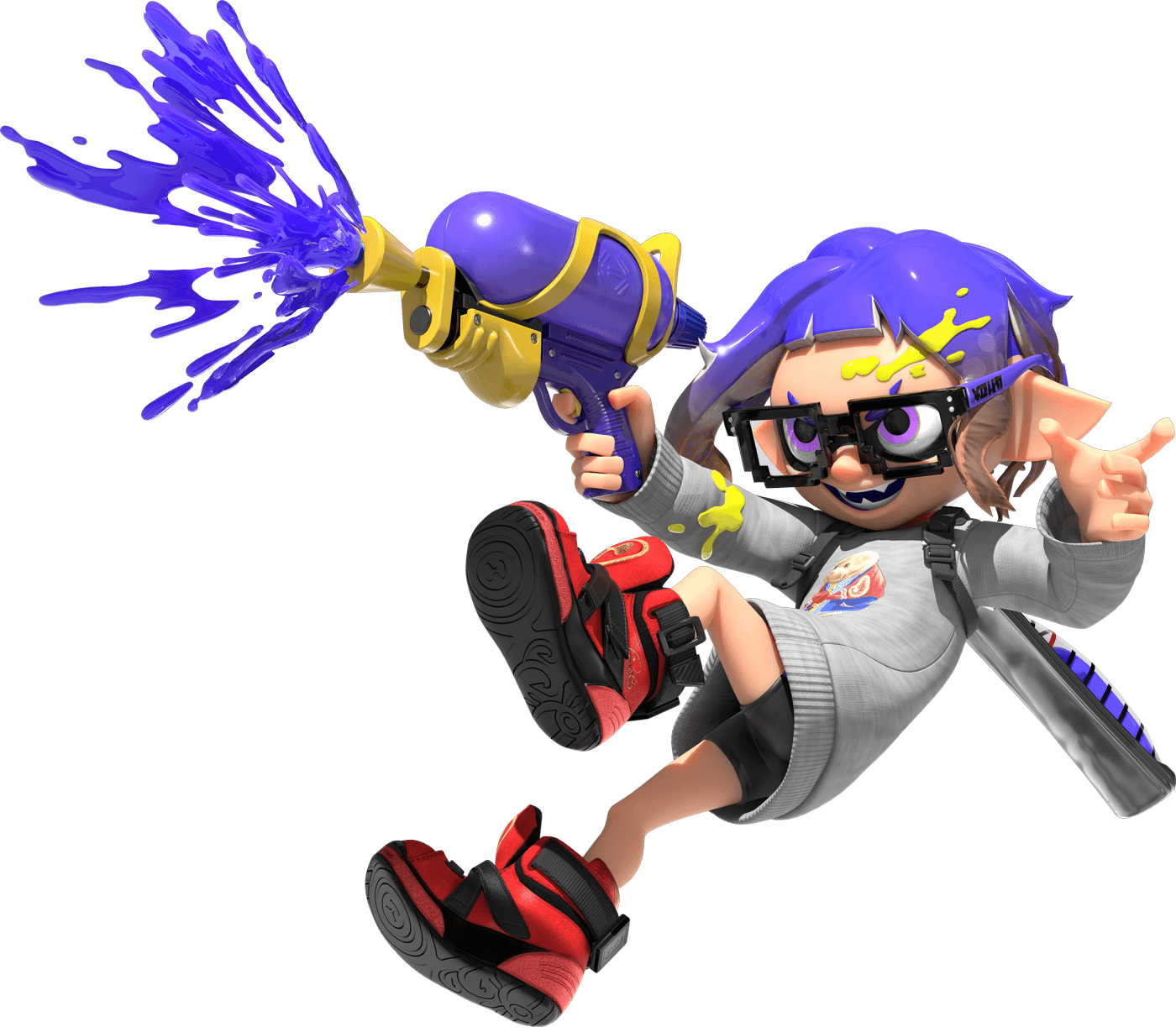
Ask an Inkling where they came from and they will probably shrug and go back to their Turf War. Ask the Sunken Scrolls and you get a much stranger answer. Over the long ages after the seas rose, cephalopods left the water, grew legs, learned to talk, and eventually invented the roller. It is one of the most charming evolutionary tales in any video game, and it is told almost entirely through background detail.
The evolutionary chart
One Sunken Scroll from the first game lays it out as a museum-style chart. At the bottom is an ordinary squid. Step by step it acquires a more upright posture, a humanoid face, and finally the tentacle "hair" and sneakers of a modern Inkling. It is a playful riff on the classic "march of progress" illustration, and it tells us that Inklings are not squids that learned a trick. They are a genuinely new species that kept the squid form as part of its biology.
The same process, presumably in a different lineage, produced the Octarians. Octolings are the humanoid form of octopus stock, and the wider Octarian population includes creatures that look far more like their ancestors: the tentacled Octotroopers, the hovering Octocopters, and the enormous Octoweapons that are more machine than animal. Fans theorize that the two species diverged early and evolved in parallel, one favoring the open coasts and the other the deep sea and sheltered caves.
What makes a cephalopod a cephalopod
Inklings and Octolings share a few traits that define everything about how they live.
They change form. An Inkling can swap between a humanoid "kid" form and a squid form at will. In squid form they swim through ink of their own color at high speed, hide inside it, and climb painted walls. Octolings do the same thing as octopuses. This is the single most important mechanic in the series, and it is treated in-universe as simple biology, the way we treat walking and running.
They are made of ink. Or at least, they produce it and are sustained by it. An Inkling drenched in ink of a rival color is "splatted," bursting into a puff of ink and respawning at their team's spawn point. It is implied that respawning is normal and painless in Turf War, though the story modes and the Octo Expansion make it clear that not every situation is so forgiving.
They cannot swim in water. This is the great irony of the series. Creatures descended from the ocean dissolve if they fall into it. Every stage's water hazard is a reminder that the Inklings' ancestors gave something up to walk on land.
They mature into their humanoid form. In-game text and interviews establish that Inklings gain full control over their transformation around age fourteen, which is exactly when they are allowed to start playing Turf War. Inkopolis is a city run by and for teenagers because that is the age when a squid becomes a person.
Everyone else in the sea
The cephalopods are not alone. Inkopolis and Splatsville are full of other sea life that made the same climb: jellyfish who run clothing shops, a horseshoe crab arms dealer, sea urchins who hustle gear in back alleys, a shrimp with a food truck, a sea cucumber who drives a train, and a manta ray who is one of the most beloved pop idols in the Splatlands. The Salmonids evolved into something fiercer and stranger, an entire warrior culture that raids the coasts in tides.
This is why Commander Tartar's disgust is so telling. To the AI, the "sea creatures" were an unworthy heir to humanity because they were frivolous and violent. But the games are gently insistent that the opposite is true. The sea creatures built a society where the old war was turned into a game, where former enemies can share a stage, and where a giant isopod can collect little cakes for fun. They evolved into something humanity never quite managed.
A squid crawled out of the sea and, after a few thousand years, asked for a pair of shoes.
Loose ends fans still argue about
The lore leaves a few gaps that have fueled a decade of theorizing. How long did it take Inklings to evolve, given that the flood was twelve thousand years ago and Judd apparently woke up to find them already there? Are Salmonids capable of developing humanoid forms, or have they simply chosen not to? And what exactly is the relationship between the ink an Inkling produces and the paint-like ink dispensed by Zapfish-powered equipment?
The games are content to leave these questions open. That restraint is part of why the world feels alive: it was clearly imagined in more detail than it shows, and every new game adds a piece rather than an explanation.